Portosole, This Is Heron
Shortly after leaving the harbour in Menton, we crossed the border into Italy. We lowered the French courtesy flag and hoisted the Italian one. After just 12 nautical miles, we prepared to enter Sanremo.
“Portosole, this is Heron, Heron,” we dutifully called on the VHF as Heron’s bow pointed between the two harbour lights.
“Hello Heron. This is Portosole,” came the immediate reply.
What on earth?
The previous year in France, we had entered a dozen harbours. Not once had anyone answered our calls. But here in Italy, they replied — and even in English.
The conversation continued, and after we had answered a couple of questions, Portosole concluded:
Look for the ormeggiatore
“OK. Look for the ormeggiatore. He will guide you to your berth.”
We looked around the harbour. At the end of a pontoon, a man was waving to us. That had to be our ormeggiatore. We motored over to him and were greeted with a smiling “Buona sera.”
We reversed Heron into the berth. When we were a couple of metres from the pontoon, the man pulled a mooring line out of the water so that we could reach it with the boat hook. He then took our stern lines, passed them through a ring and handed them back to us.
A sign saying “Welcome to Italy” or something similar was really all that was missing to make the reception perfect.
Sanremo in Liguria
Sanremo is in Liguria, one of the smallest of Italy’s 20 regions. The coastline, known as the Italian Riviera, stretches from the French border in the west to La Spezia, close to Tuscany, in the southeast.
During the 19th century, many wealthy English people and artists settled in Liguria, among them Charles Dickens, Lord Byron and Shelley. Hans Christian Andersen also lived here in the 1830s, more precisely in the town of Sestri Levante, where an Andersen Festival is held every year.
There are many harbours along this almost 300-kilometre stretch of coastline. Another harbour is never more than a few hours away. Perfect for daysailing.
Between the two World Wars, Sanremo was a favourite destination for the European jet set. There were quite a few megayachts in the harbour, although nowhere near as many or as large as those we had seen in Antibes in France. In general, Sanremo seemed far less jet-set than the towns along the French Côte d’Azur.
Next stop was Imperia
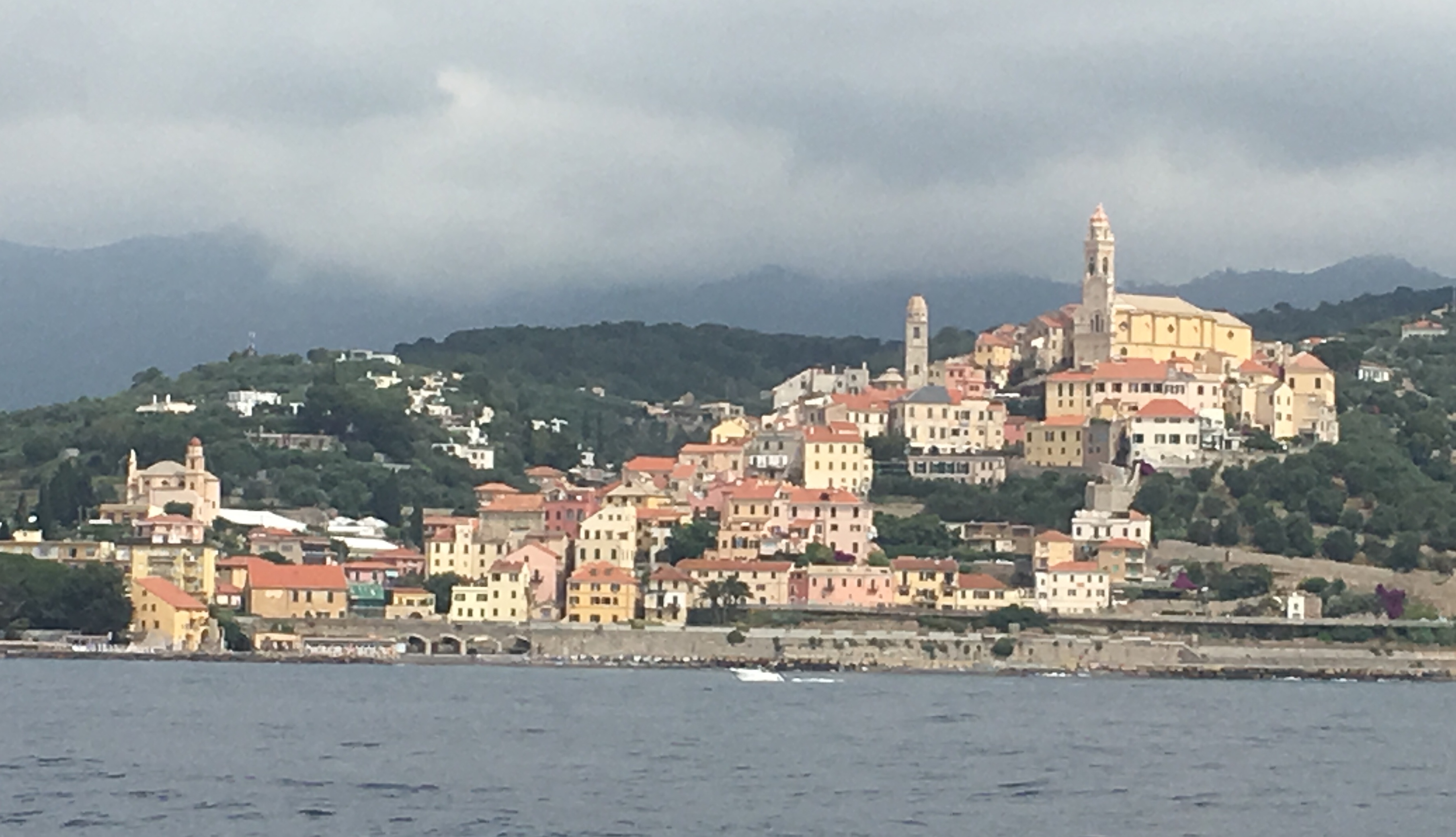
From a long way off, we could see the peninsula with its pastel-coloured buildings and the large 18th-century cathedral rising prominently above them.
In 2007, a company working in a consortium with private investors began expanding the harbour. An 800-metre breakwater was built out into the Mediterranean, and a new marina with space for 1,300 boats was constructed as an extension of the old harbour.
Then the financial crisis struck and demand for pleasure boats plummeted. Financing became a problem, the consortium went bankrupt and construction stopped.
Eight years after the bankruptcy, the marina was still unfinished. Most of the many pontoons stood deserted. It all felt rather ghostly.
But in the old harbour, where we were given a berth, life seemed largely unaffected by the financial problems — apart from the fact that the municipality had taken over the administration and substantially reduced the harbour fees.
We stayed in Imperia for a couple of days.
We visited the cathedral, enjoyed the atmosphere around the harbour and in the beautiful old town, and gradually got used to the fact that we were now in Italy.
After a couple of days, we sailed to Loano
As we entered the harbour, we discovered that there was a problem with the electricity onboard. We checked the cables and connections. Everything looked fine.
A fault in a boat’s electrical system can be dangerous, so we called an electrician — Carlo, who advertised that he spoke English.
“It is your batteries,” Carlo said immediately when we showed him the problem.
“How old are they?” he asked, staring at us in disbelief when we told him they were in their tenth season.
“You need to replace them now,” he concluded without hesitation.
… Hmm.
We had expected the batteries to last until the end of the season and had planned to spend the winter having lithium batteries installed. They are based on newer technology and offer several advantages over traditional lead-acid batteries. Lithium batteries were still very expensive, however, which was one reason they were not yet widely used on pleasure boats.
“It may be good, but I don’t want to be the first,” was another reason, Carlo pointed out, before installing a new bank of lead-acid batteries the following day.
Loano also has a new marina
The marina was completed in 2014. It is well integrated with the beautiful old town, offers unusually good shelter from winds in all directions and has the finest shoreside facilities we had seen in a marina so far.
One afternoon, we climbed aboard a small tourist train. The young driver took us at a brisk pace up a steep and winding mountain road through a couple of small villages. It was wonderful to get a little way inland and experience the mountain landscape and the clean, clear mountain air.
Our destination was the Grotte di Toirano, which was “worth a visit”, according to our Italian Waterways Pilot.
The caves, discovered as recently as the 1950s and 1960s, revealed beautiful stalactite and stalagmite formations, skeletons of a species of bear that became extinct 30,000 years ago, 12,000-year-old human footprints and handprints, and a small lake where, for reasons that remain unexplained, living fish have been observed.
On to Genoa?
“Turns its poverty towards the harbour.”
“Unsafe after dark.”
“A dirty port city.”
We had heard plenty of negative things about Genoa and had planned to skip the city altogether.
But the French couple on the neighbouring boat spoke warmly about Genoa and told us they were sailing there the following day.
We decided to change our plans and agreed to sail there with them the next morning.