36 Hours Until Ianos
“It depends on how well we’ll be sheltered from that direction,” our English neighbour explained, pointing towards one of the mountains on the small island of Meganisi.
Like us, he had seen the forecast warning that Hurricane Ianos would reach us within 36 hours.
“We were here during a storm a few years ago. I think we’ll take our chances and stay,” he continued, adding, “If you want to stay here too, you’d better go in and talk to them now.”
We went into the taverna. The owner’s son-in-law was sitting there. He was the one responsible for the pontoon.
“No, all booked,” he replied without looking up, in such a dismissive tone that we didn’t even consider asking what we were supposed to do instead.
What Do We Do Now?
We went back aboard Heron to discuss our options.
The wind would start in the northeast. So Nidri, where we had been the day before, was a definite no-go.
What about Sivota, where we had been two days earlier? It was certainly a sheltered bay, but would the pontoons be able to withstand gusts of up to 47 m/s?
Maybe. Maybe not.
We didn’t feel like finding out.
Then there was Lefkas. It had a large and well-sheltered marina about two hours’ sailing away.
Encouraged, we called the marina.
“We’re very busy right now. Everybody is calling. We’re fully booked. Try to book on our website,” said a clearly stressed woman, not sounding particularly encouraging.
What about anchoring in one of the many bays in the area?
We could certainly find one that offered shelter. But would the anchor hold in a hurricane? What if other boats in the bay started dragging? And would it even be possible to sail to another bay when the wind shifted the forecast 90 degrees?
There were too many unanswered questions for us to feel comfortable pursuing that option.
What about Cleopatra Marina on the mainland?
We called.
“Let me see,” the woman replied, then asked, “How many days did you say?”
“Four,” we answered as humbly as we could.
“Four days,” the voice repeated. “Eleven metres. Let me see, let me see.”
What felt like an eternity passed.
Then came the liberating words:
“That’s OK. Be here before two o’clock. Look forward to seeing you.”
Seeking Shelter from Ianos
We were not the only ones seeking shelter from Ianos.
As we sailed out of the bay, we saw a small armada of yachts in the narrow waters between Lefkas and the mainland. All of them were heading north.
Away from Ianos — or “the spinning top”, as it was rather reassuringly being called on Facebook.
When we entered the Lefkas Canal, much of the armada gathered together. Some had been lucky enough to secure a berth in Lefkas Marina. Others, like us, had been forced to seek shelter farther north.
When the bridge finally opened, we found ourselves in the middle of the fleet of northbound boats.
The bridge opened and we sailed north along the mainland coast towards Cleopatra Marina.
About an hour later, we reached the two buoys marking the entrance to a lagoon with the rather unpronounceable name Amvrakikos.
A Remarkable Lagoon
The lagoon is one of the largest wetland areas in Greece and is protected under an international convention. It has a rich variety of wildlife, including sea turtles, rare species of dolphins and almost 300 species of birds, several of which are endangered.
Two rivers flow into the lagoon, which is separated from the Ionian Sea by a narrow strait. This, combined with its relatively shallow waters, means that the water here is warmer and less salty than in the Ionian Sea.
It is also one of the few places in the Mediterranean with tides strong enough to create currents of up to three knots in the strait.
We sailed between the two buoys and entered the narrow passage.
In the Wake of History
It was through these waters that one of Rome’s rulers, Mark Antony, and his ally, Queen Cleopatra of Egypt, sailed on the morning of 2 September 31 BC.
Their fleets had been lying in the lagoon for several months and were now forced out into the Ionian Sea.
Waiting for them was Rome’s other ruler, Gaius Octavian, together with his general Agrippa.
Shortly after midday, the battle between almost 800 warships began.
It ended the same day.
Gaius Octavian was victorious. The civil war that had begun after the assassination of Julius Caesar was over.
The Republic became an empire, with Gaius Octavian — who changed his name to Augustus — as its first emperor.
For the next several hundred years, there was relative peace throughout the lands surrounding the Mediterranean, which the Romans called Mare Nostrum — “Our Sea”.
We Arrive at Cleopatra Marina
Preveza lay to port and Cleopatra Marina to starboard. Behind the marina, we could see several thousand masts belonging to boats stored ashore at the three large boatyards.
As we prepared to enter the marina, the tide was turning, allowing us to approach and moor without having to deal with a cross-current.
Over the course of the following day, the marina began to fill up.
“I was at the town quay in Preveza. It was terrible. I haven’t slept at all,” our Italian neighbour told us before disappearing below, red-eyed, to catch up on some of the night’s lost sleep.
Strange.
We had had a completely peaceful night.
Cleopatra Marina had been sheltered from the strong southeasterly wind that had blown directly onto the town quay in Preveza on the opposite side of the strait — less than a quarter of a nautical mile from where we were lying.
Ianos Arrives
During the afternoon, dark clouds began gathering in the sky to the south.
The stream of boats seeking shelter inside the lagoon through the strait came to an end.
Boats now trying to enter the marina were told:
“Sorry. Fully booked.”
Even though there were still vacant berths.
(Later, we learned that if the marina is completely filled, the strain on the pontoon anchors and mooring lines can become so great that there is a risk of them breaking free.)
Extra mooring lines were rigged. Sprayhoods and biminis were taken down. Dinghies were deflated or secured more firmly, and loose objects were either tied down or taken below.
Prepare for the Worst
“You need to get further away from the pontoon,” the harbourmaster told us.
Before we really knew what was happening, he and three other men were aboard Heron.
They slackened our stern lines and pulled Heron a couple of metres farther out into the marina basin. Then they asked us to start the engine and reverse at full power.
When we were once again just under two metres from the pontoon, they secured the stern lines.
Heron was now held completely taut, with equal tension on all the mooring lines.
“You never know. Better prepared for the worst,” the harbourmaster laughed before he and the three men stepped off Heron and moved on to secure our Italian neighbour’s boat.
But it wasn’t only us and our Italian neighbour whose moorings were checked.
The four men inspected the lines of every boat in the marina, whether occupied or unattended. On the occupied boats, they politely asked permission to come aboard.
On the unattended ones, they simply stepped aboard.
Ianos Passes Us
After dark, it began to rain.
HEAVILY.
It was still pouring when we went to bed.
As dawn approached, we woke to the sound of the wind howling through the rigging.
There was no doubt.
Ianos had arrived, blowing from the northeast.
Cleopatra Marina was no longer sheltered.
But there were no waves.
Heron lay securely in her tight mooring lines despite the powerful wind.
We fell asleep again.
When we woke a couple of hours later, the wind had almost completely died away.
All day and all night it rained and rained and rained.
Early the following morning, the wind returned. This time from the northwest.
It was as strong as the day before, but again there were no waves.
During the morning, the rain finally stopped, and by late afternoon the wind had died away completely.
Ianos had passed us.
We had been lucky and had only caught the outer edge of Hurricane Ianos.
Widespread Destruction
Just twenty nautical miles farther south — where we had come from — they had not been nearly so fortunate.
There, Ianos had struck with full force and caused widespread destruction.
People had died. Houses had been flooded. Villages were buried beneath metre-thick layers of rocks and mud. Trees had been uprooted. Cars and houses were destroyed.
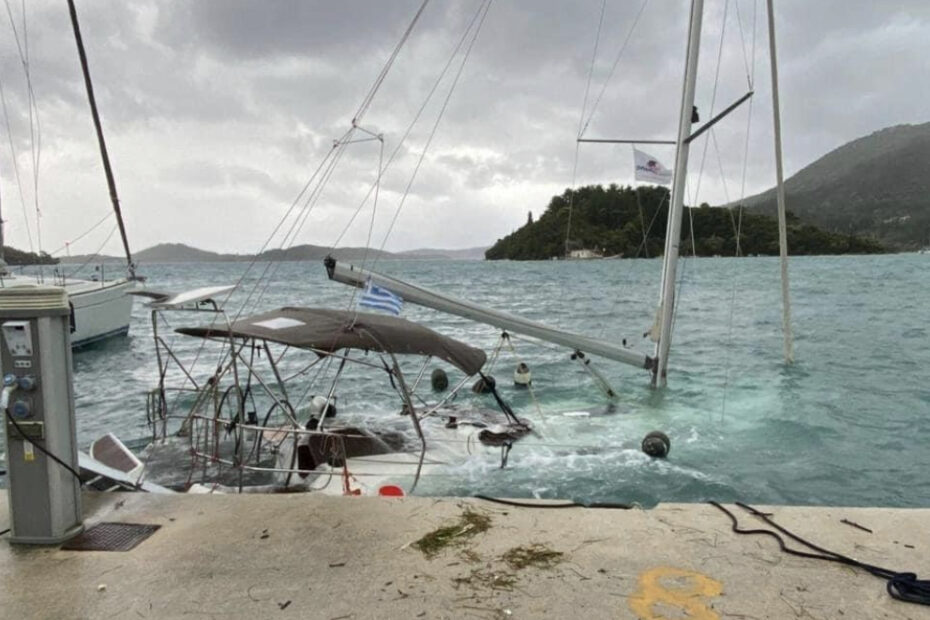
Around fifty yachts had sunk at their moorings, and an unknown number had been washed ashore.
Not Just Sunshine and Azure Seas
“The Mediterranean isn’t all sunshine and azure-blue seas,” someone wrote on their blog.
… We couldn’t agree more.