So Beautiful Going East
“It is so beautiful going east. I wouldn’t bother going west,” said David, who had come aboard with his wife Jill to give us some tips about sailing in the Mediterranean.
After much deliberation, we decided to follow their advice and spend the next month exploring the French coast east of Marseille.
The Mediterranean is vast
We have great respect for the Mediterranean. It is vast. Almost five times larger than the North Sea. It is 4,000 kilometres from Gibraltar in the west to Israel in the east, and 800 kilometres from Croatia in the north to Libya in the south. The average depth is 1,500 metres, and at its deepest point it reaches 5,200 metres.
There are tides, even though the entrance from the Atlantic at Gibraltar is only 14 kilometres wide. The Mediterranean has a rich marine life, including whales, dolphins, sharks and sea turtles, and more than 20 countries have a Mediterranean coastline.
Eight winds
There are eight different prevailing winds in the Mediterranean. The Mistral, which blows across southern France, is one of them.
It develops when a low-pressure system over the Gulf of Genoa is filled by high pressure over the Bay of Biscay. The airflow draws cold air down from the Alps and can reach hurricane force.
When the Mistral comes from the northwest, it usually lasts for one to three days. From the northeast, it can last for a week – sometimes longer. A man in Port Napoléon told us that he had once experienced it blowing for 52 days.
Sea breeze
When the Mistral is not blowing, the difference in temperature between land and sea creates a sea breeze. It builds during the day. The wind can become quite strong, but dies away completely when the temperature difference evens out in the evening.
As the American we met in Toul put it:
“The Med is a shitty place to sail. Either the wind blows the hell out of you or it does not blow at all.”
Ready for the open sea
We prepared Heron for sailing at sea. We folded up the bicycles, stowed loose items in the forward cabin, rigged safety lines on deck, checked our safety and emergency equipment, and once again studied the weather forecast and the route we had plotted on the chartplotter, with the iPad as backup.
Early that evening, a Danish boat arrived. It was John. He had lived in southern France for many years and had sailed in the area for almost as long. He was now in Port Napoléon to have his boat hauled out and the bottom cleaned and painted.
We invited him aboard, received plenty of good advice about sailing in the Mediterranean and were recommended to use a weather app from the French meteorological service, Météo.
To top it all off, he generously gave us his paper charts of Corsica.
The next morning, we said goodbye to John, slipped our moorings and left Port Napoléon. Once clear of the sheltered bay, we set a course for Marseille and found a light wind directly against us.
There was still some swell left over from the days of Mistral. It was now running almost at right angles to the wind, making for a slightly uncomfortable passage. But it was wonderful to have plenty of water beneath the keel, to be free of locks and once again to see the horizon.
Îles du Frioul
After a couple of hours under engine, the Îles du Frioul emerged from the heat haze. The archipelago, three kilometres off Marseille, consists of four islands. Two of them are connected by a low concrete causeway.
The marina has more than 100 berths for visiting boats, but there were hardly any visitors.
As we entered, we were met by a young member of the harbour staff.
“You can moor where you want to,” he shouted to us in English with a smile before opening the throttle and speeding away.
About 150 people live on the islands. They are a popular destination for day trips and are connected to Marseille by an hourly ferry.
That evening, sitting in the cockpit, we watched the lights of Marseille and the former prison Château d’If on the island of If. This was where Dumas imprisoned his hero Edmond Dantès for 21 long years in The Count of Monte Cristo.
The next morning, we swam in the crystal-clear water before setting off later in the morning towards Cassis.
It is so beautiful
David and Jill were right.
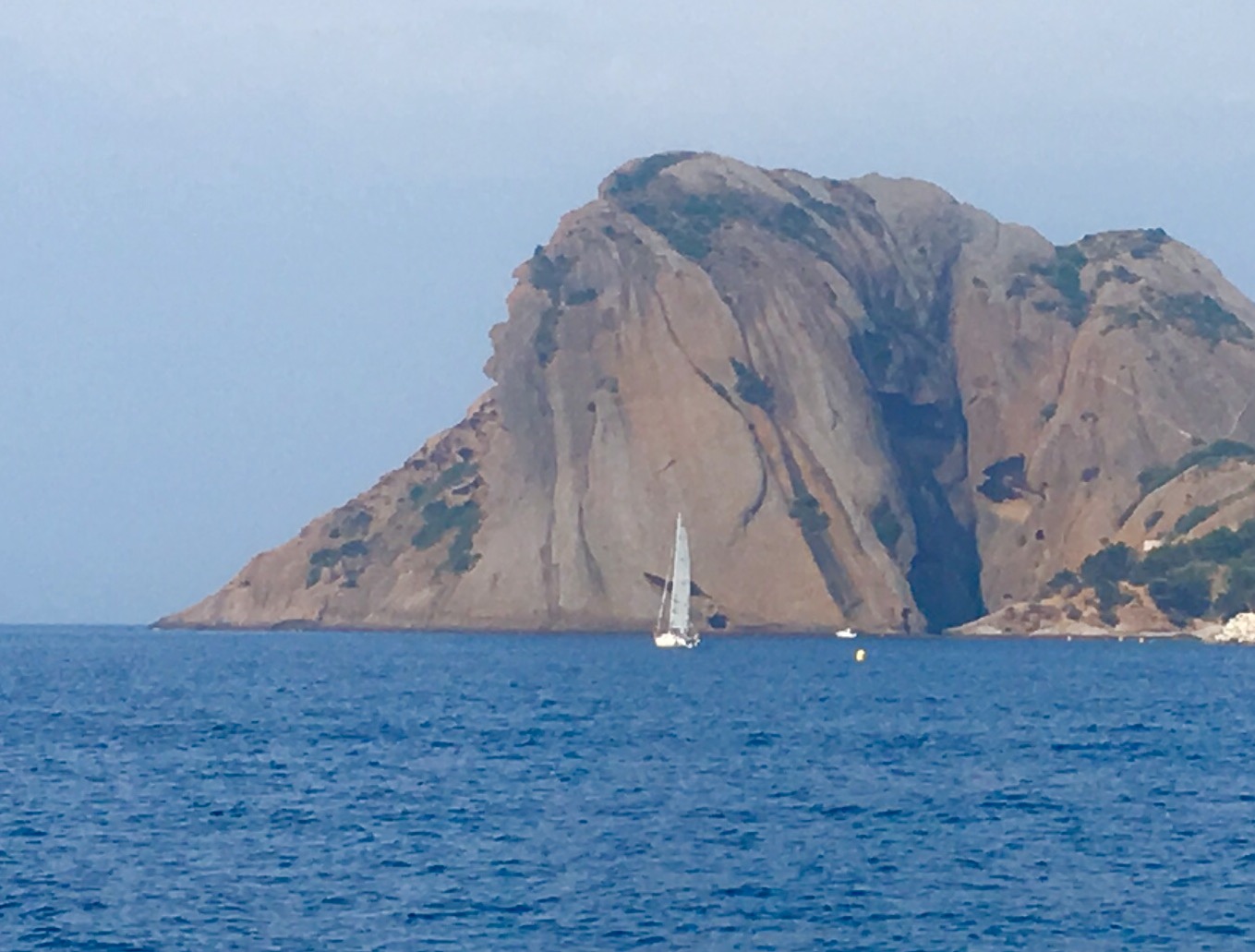
The coastline was spectacular. On our port side lay Calanques National Park, an impressive limestone massif cut by deep, narrow inlets – calanques, as they are called in French.
We kept well clear of the beautiful and dramatic coast, but could see other boats sailing close inshore and in and out of the many coves.
Cassis
“Have you reserved a berth?” the harbourmaster asked us in French as we entered the marina in Cassis.
He shook his head resignedly and muttered “complet” when we said no, but nevertheless managed to find us a berth.
Cassis is a charming town and a popular tourist destination. The harbourfront was packed with restaurants, and during the afternoon they filled with customers.
There were also a dozen boats taking tourists sightseeing in Calanques National Park and divers out to some of the many dive sites.
We stayed in Cassis for three days. We swam from the two beaches by the harbour, watched life in and around the marina and enjoyed being in a town with plenty going on.
There was a good breeze when we left Cassis and continued along the coast towards La Ciotat.
La Ciotat
The wind was with us and came from the land. The sea consisted of little more than a gentle swell.
We unfurled the genoa three-quarters of the way and switched off the engine. For the first time on the journey, we were moving under sail alone, gliding along with the spectacular coastline on our port side.
Having learned from our previous arrival, we called La Capitainerie in La Ciotat and reserved a berth in the marina.
It turned out to be completely unnecessary. We were the only boat on the visitors’ pontoon. The harbour office was closed, and the only life on the quay was a group of teenagers swimming and performing tricks on their mopeds, clearly trying to impress the girls.
It continued until well into the night.
The next morning, we sailed into the old harbour. Here we found the charming atmosphere of cafés, restaurants and shops that we had been looking for in La Ciotat.
Sanary-sur-Mer
Our next destination was Sanary-sur-Mer – a medium-sized harbour surrounded by a picturesque town. The visitors’ pontoon was only a few minutes’ walk from the town centre.
The streets, cafés, shops and restaurants were full of people. Many seemed to be enjoying their retirement here. Discreetly and quietly.
The architecture reflected the atmosphere. No flashy high-rises. Just well-kept villas and low-rise buildings blending beautifully into the surrounding landscape. A striking contrast to the France we had sailed through in the northeast.
On a walk through the area, we found the house where Thomas Mann lived from 1933 to 1934 after the Nazis had forced him to flee Germany. Other German artists had sought refuge in the same neighbourhood. A few years later, they had moved on to safer countries such as the United States and Portugal.
Caught by the Mistral
Once again, the Mistral caught up with us.
This time it began with a violent thunderstorm and rain driven against us by gusts so powerful that we could barely see the boats moored on the pontoon just a few metres opposite us.
The Mistral continued, and over the next few days it became cooler – 24°C – while the sun continued to shine as before. Farther offshore, the sea built up and sent large breaking waves into the bay.
Heron was well sheltered from the wind but tugged at her mooring lines because of the surge created by the rough sea outside the otherwise well-protected harbour basin.
We stayed in Sanary-sur-Mer for a week. After three days, the Mistral stopped just as suddenly as it had begun, and we sailed on.
Heading east