Nice in September
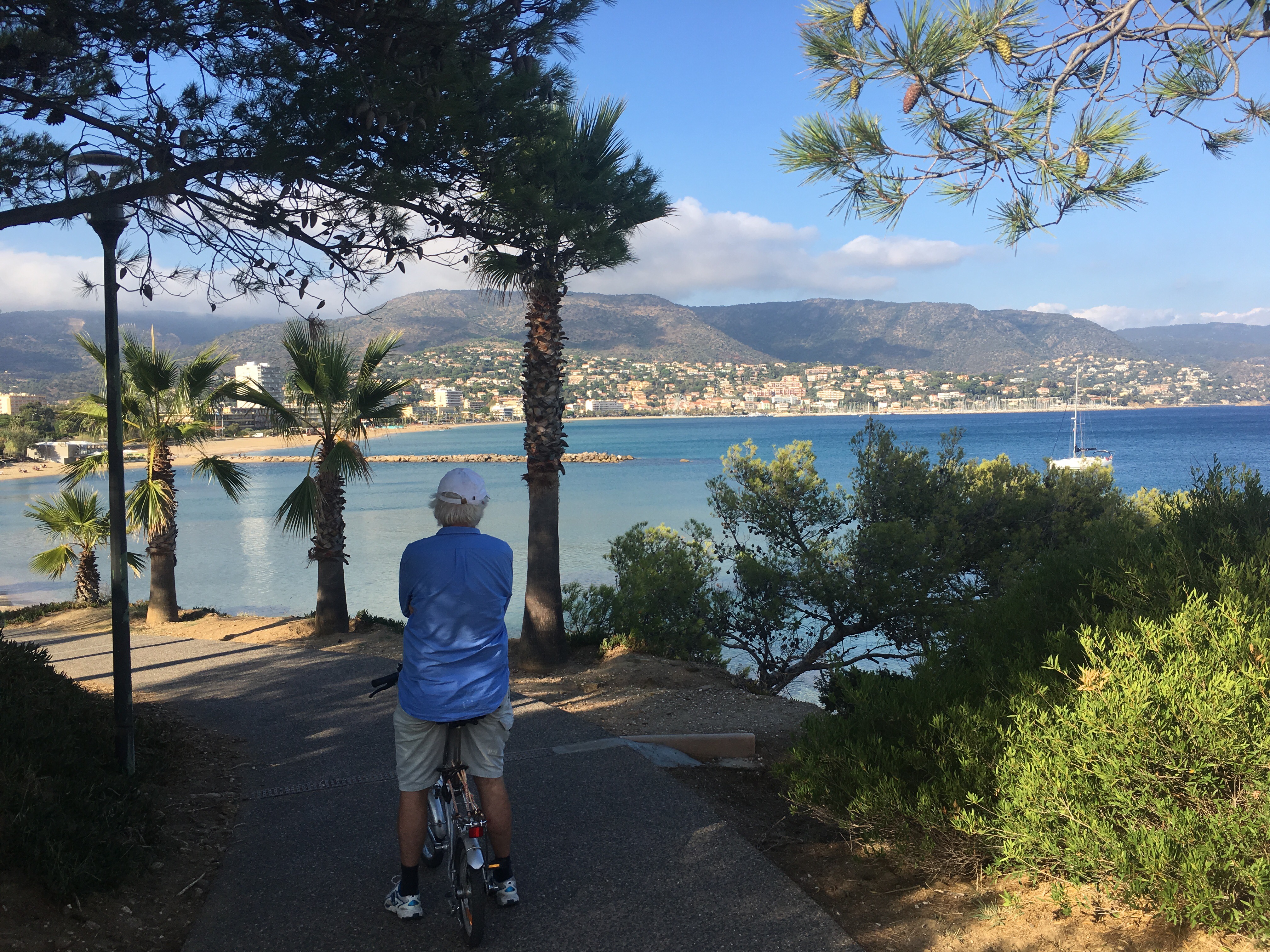
At the end of September, we landed at Nice Airport early in the morning and stepped out into weather that felt like a beautiful Danish summer day.
It is just under a two-hour drive from Nice to Le Lavandou, where we had left Heron almost three months earlier.
But we took our time and drove along the coast for a couple of hours. From there, we headed inland over the mountains on a road with numerous picturesque hairpin bends. They brought to mind a scene from The Saint, in which Roger Moore drives down towards Monaco, unable to control his speed because a villain has sabotaged the brakes of his white Volvo P1800.
We have also primed the keel
Late in the afternoon, we arrived at the boatyard in Le Lavandou.
Communication between us and the boatyard had become rather one-sided during our stay in Denmark. In an email, written in Google-translated French, we had asked for a quote for painting the bottom. We had received a reply to that. After that, there had been complete radio silence from the yard. Even an email translated by Sarah – which of course guaranteed that we were now communicating in genuine French – remained unanswered. Just like our many phone calls.
So in a way, we were relieved to discover that Heron was standing almost exactly as we had left her.
Almost . . . .
Yes, because there was one difference: the bottom had been painted.
“Looks good, doesn’t it?” said the boatyard manager, pretending to wipe the sweat from his brow with an expression suggesting the burden of all his hard work. Smiling, he added, “And we have also primed the keel, as you asked us to.”
The next day, we replaced the zinc anodes and checked the seacocks. A couple of hours later, Heron was effortlessly lowered into the water by the large crane truck, operated by the manager himself.
A cure for heel spurs
For the next couple of days, we were on a diet of vegetables, fruit and at least three litres of water a day. It had been prescribed by the town’s chiropractor. For more than an hour, bursting with energy, he had twisted and bent me in an attempt to cure what everyone believed was a troublesome heel spur. He had finished the treatment by prescribing the strict diet – perhaps inspired by the fact that he was also trained in the alternative practice of kinesiology.
Back on land
Once well into the diet, we began preparing Heron. Another check of the seacocks revealed that one handle, which turned suspiciously easily, was not connected to the valve ball at all. This meant that the valve could not stop seawater from entering if and when that became necessary.
There was quite a lot of swearing about why the hell those damn seacocks hadn’t been checked properly while Heron was ashore. But swearing didn’t solve the problem. There was nothing else to do but haul her out again and replace the valve.
We approached the boatyard manager.
“Rien de problème,” he smiled obligingly at the unexpected opportunity to make some more money from his crane truck.
A couple of hours later, Heron was back on land. A small workshop next to the boatyard immediately began replacing the valves and through-hull fittings. By the following afternoon, Heron was back in the water.
The bow thruster won’t switch off
Like many other boats, Heron has a bow thruster. The propeller is mounted below the waterline and powered by a 3 kW electric motor. Both are located in the bow and operated from a control panel in the cockpit. As we reversed out of the dock and headed towards our berth, we used the bow thruster several times to keep Heron in the middle of the narrow passage between the two pontoons.
Suddenly, nothing happened when I pressed the control panel.
The lack of response was not in itself a problem. We can easily manoeuvre Heron without the bow thruster.
The problem was that the electric motor wouldn’t stop. It kept roaring away, pushing the bow to port at full power no matter how hard we pressed the controls.
Now manoeuvring became difficult
The bow swung with a bang into the guardrail of a boat on our port side. We went full astern. The runaway bow thruster was still pushing the bow to port. Then I applied power ahead. That worked better, but we were still not entirely in control of where Heron was going in the narrow passage.
A 3 kW electric motor generates heat. A lot of heat. And if it runs for too long, it generates so much heat that it burns out.
Suddenly, the safety course we had taken several years earlier proved useful. Almost by reflex, we remembered that there was a separate cut-off switch for the electric motor.
Pia rushed below, turned the switch, and the runaway motor stopped immediately.
Our subsequent inspection of the system revealed that the short circuit had been caused by a defective control panel.
Why did it happen?
It is difficult to know how a fault like that suddenly develops. Whether the villain who sabotaged The Saint’s car had a hand in it, we’ll probably have to leave unanswered.