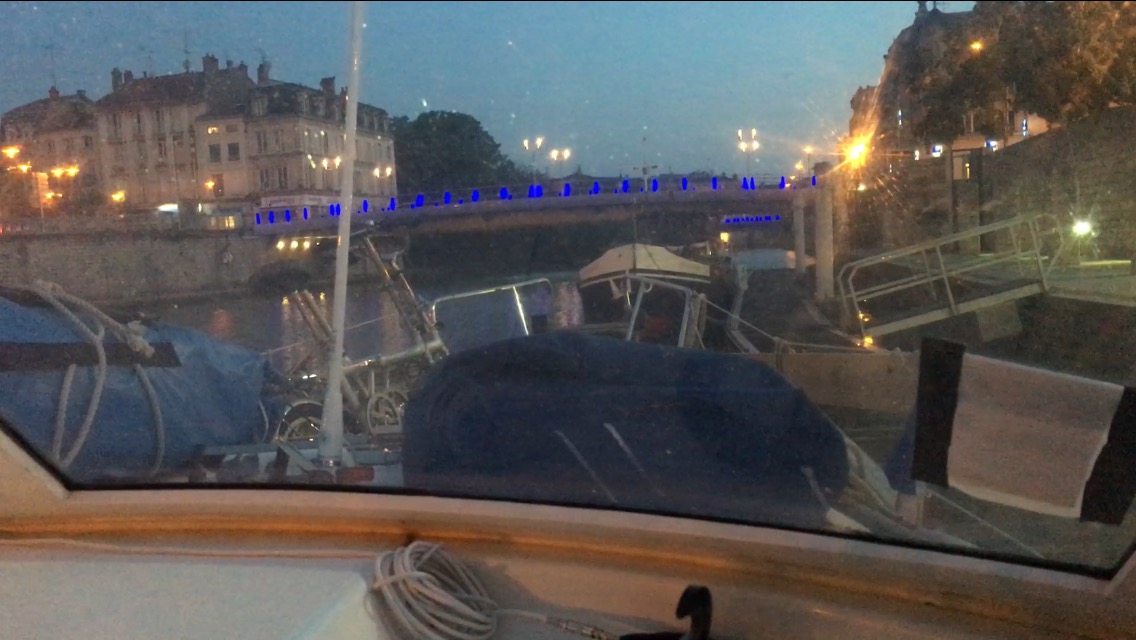
Dun-sur-Meuse
The pontoon at Dun-sur-Meuse lies in the middle of a beautiful natural area where people fish, cycle, run and go for walks.
As usual, we were the only boat at the pontoon.
After a couple of hours, there was suddenly some activity at the lock a few hundred metres from where we were moored. When the gates opened, a boat appeared. It slowly left the lock chamber and moored behind us. The flag at the stern was red and white. Probably Swiss, we thought. But when the wind stretched it out fully, we saw that it was the Danish flag, Dannebrog.
Company – and a Danish boat at that
Finally, another boat for company – and a Danish one at that.
The boat belonged to Kurt and Bente. They had lived in Switzerland for more than 30 years, retired five years earlier and now used the boat as their home.
The boat, a 28-metre river barge weighing 90 tonnes, had been built for them in 2006. They had done the tasteful and functional interior fitting themselves. It had taken them six years, but the result was truly state of the art. They cruise from April to October and also offer fully catered cruises for tourists.
Our own lock keeper
The next day, it was time to try the manually operated locks. The day before, we had called VNF and arranged to leave at 11 a.m., with Verdun as our destination.
As we approached the first lock, we wondered whether VNF had understood our French well enough to know that we had an appointment.
No problem at all.
When we reached the lock, a man from VNF introduced himself as our éclusier – our lock keeper. He waved us into the empty lock chamber, took our mooring lines and operated the lock gates by turning the handles.
Once we had been raised to the new water level, we sailed out of the chamber and said au revoir to our éclusier. He then drove to the next lock. By the time we arrived, the chamber was already open and waiting for us.
Easy, quick and luxurious to have your own éclusier.
Finally warm
At last, it had become warm. Wonderful to sail in light summer clothes and do without thick sweaters, socks, rubber boots and waterproofs.
The landscape was incredibly beautiful. The sun was shining and the birds were singing. Cows, horses, trees, forests and yellow fields slowly drifted past us.
Pure Morten Korch.
A “rodder”?
Suddenly, we spotted an animal in the water ahead of us. It sat low and heavy in the water and was about 50 centimetres long. When it reached the sheet-pile wall on the right bank, it dived beneath the surface and quickly disappeared behind us.
Was it a gigantic rat? An enormous water vole? An otter? A beaver? A mink?
There were plenty of possibilities. We agreed that the animal looked more than anything like a cross between a rat and an otter. So, very logically, we decided to name our zoological discovery a “rotter” – a cross between rat and otter.
That evening, while we were securely moored at the fine pontoon in Verdun, another “rotter” swam swiftly past us against the current. So, apart from being about 50 centimetres long, our “rotter” was clearly also a very strong swimmer.
Verdun is deceptive
With its attractive shops, lively cafés, numerous cosy restaurants, parks, monuments, statues, cathedral and museums, Verdun gives the impression of being a large city. But its population is only around 18,000.
The city is best known for the Battle of Verdun during the First World War.
It lasted 300 days. By the time it was over, 50 million shells and mines had exploded. Some 700,000 soldiers had been killed, seriously wounded or were missing.
And the front line was more or less where it had been when the battle began.
The Battle of Verdun
We went to Fort Douaumont, one of the 40 forts that made up the fortress of Verdun. It has now been turned into a museum. A 45-minute guided tour gave us an impression of the appalling conditions in which the soldiers at the fort had lived.
The fort was unexpectedly captured by the Germans and, just as unexpectedly, recaptured by the French some months later. It was during the fighting at Verdun that the young Captain Charles de Gaulle was taken prisoner by the Germans.
From the fort, we walked to the Douaumont Ossuary – the cemetery and necropolis for the fallen soldiers.
In the cemetery, 16,142 identified soldiers are buried, each grave marked by a white cross bearing the soldier’s name and date of death. The graves of Muslim soldiers are marked by headstones facing Mecca.
The remains of around 130,000 unidentified French and German soldiers lie in the ossuary. The building is enormous – 137 metres long, with a 46-metre tower. It was here, in 1984, that François Mitterrand and Helmut Kohl met in a powerful symbol of reconciliation between the French and German peoples.
We returned to the boat late in the afternoon, sombre after confronting the scale of this enormous man-made tragedy.
We spent four days in Verdun and were eventually joined by no fewer than five other pleasure boats.
Vous êtes Heron?
The day before our departure, we called VNF again and asked for permission to sail to Saint-Mihiel – 40 kilometres and nine locks further upstream.
“Vous êtes Heron?” asked the voice at VNF.
“Oui,” we replied in amazement, and were rewarded with a departure time of 10 a.m. and Saint-Mihiel as our destination.
The following morning, we left Verdun in cloudy and rather chilly weather together with a large Belgian motorboat.
They were also heading for the Mediterranean. They had made the journey three times before, sailed for only a couple of hours each day and expected to reach the Mediterranean in about three months.
After 18 kilometres and five locks, the Belgians called it a day, while we continued towards Saint-Mihiel.
P.S. Any tips that might help us solve the mystery of exactly what kind of creature our “rotter” was would be very welcome.