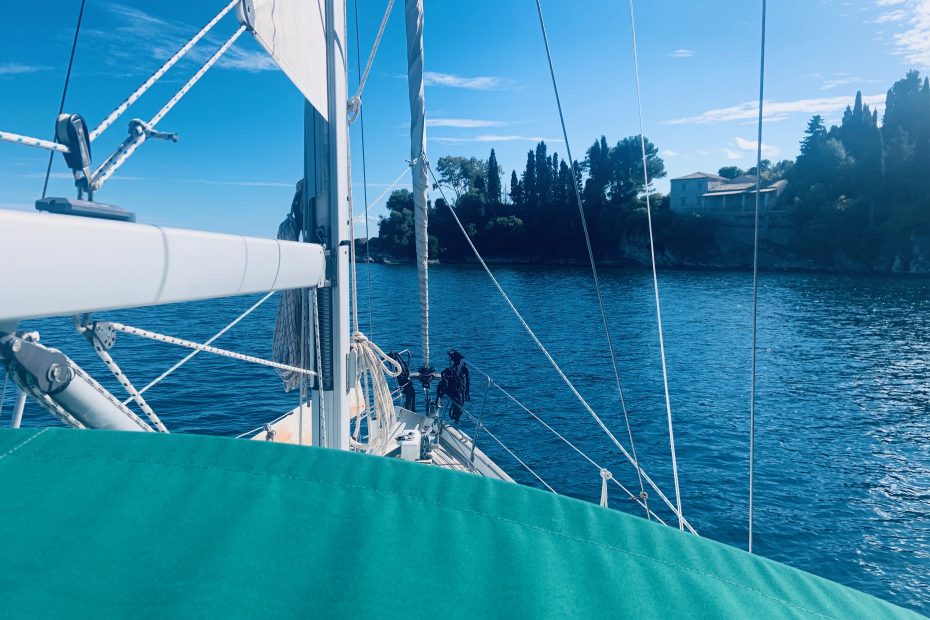
Gouvia Marina – The Largest Marina in Greece
Gouvia Marina is big. In fact, it is the largest marina in Greece. It lies well protected in a bay just north of Corfu Town. In Greek, the town is called Kerkyra, which in the unfamiliar Greek alphabet is written Κέρκυρα.
Two buoys mark the beginning of the long, wide approach channel. On the green one, someone has painted “max 4 knots” in white, with “VHF 69” underneath.
Welcome to Gouvia Marina
As we came abeam of the buoys, we reduced speed and called the marina office.
After our second call, the office responded:
“Welcome to Gouvia Marina. Stand by. We’ll come out and guide you to an available berth.”
A little later, Heron was safely moored at the visitors’ pontoon. We stepped ashore after a 24-hour passage that had taken us across the Ionian Sea to Corfu in Greece.
Three Ladies and Only One Marina Office
“Is this your first visit to Greece?” one of the three ladies in the marina office asked rather brusquely after we had shown Heron’s papers.
We nodded, and she continued:
“You can buy a DEPKA certificate here. You can pay the TEPAI tax at the post office. Just walk up to the main road and take bus number 7. And you can register the boat with the Port Police here at the marina.”
“OK. How much is the DEPKA certificate?”
“€51. But you can only pay in cash,” she replied, looking rather disapprovingly at the Visa card we had just used without any difficulty to pay the marina fee.
We went outside and found an ATM. We withdrew cash at an offensively poor exchange rate, went back to the marina office, handed the lady her €51 and received our DEPKA certificate.
One tax paid. Tick.
Then we moved on to the next one.
The TEPAI Tax
We found the main post office in Corfu Town. Took a number and waited and waited and waited.
After an hour, it was finally our turn.
It took only a few minutes to pay the TEPAI tax, which, for reasons unknown, could be paid by Visa.
Second tax paid. Tick.
Registration with the Police
Encouraged by our success, we decided to register Heron with the police in Corfu Town while we were there.
We found the police station and easily passed the first obstacle, a guard at the main entrance who asked where we were going.
Once inside the building, we were stopped by a woman at reception.
“We’re going to the first floor to register our boat at the office that is the second door on the right,” we explained when she asked where we were going.
She smiled, asked us to wait and made a phone call.
When the call ended, she was still smiling as she explained that boats had to be registered with the police at the harbour where they were berthed.
The next day, we went to the small police office in the marina. We paid a slightly grumpy female officer €15 in cash — cards were not accepted here either — and received a piece of paper stating that we had paid the DEPKA and TEPAI.
Later, we discovered that we could have saved ourselves the trip to the post office because the police — at least in Gouvia — accepted a screenshot of an online bank transfer as proof that the TEPAI had been paid.
… And suddenly paying those peculiar Greek charges would not have been quite so complicated.
Many Islands in Greece
There are a lot of islands in Greece. Some say 6,000, others say 1,200.
Both are right.
It depends on when a piece of land surrounded by water is considered large enough to be called an island.
The 1,200 islands — or 6,000, if you prefer — are divided into seven island groups.
The Ionian Islands, of which Corfu is a part, lie furthest west.
The waters between the islands and the mainland are surrounded by high mountains. There are countless sheltered bays with crystal-clear water, good anchorages and tavernas right down by the shore. In several places, a marina lies close to a small town.
There is no Mistral, Bora or Meltemi here. The wind is generally light to moderate. The climate is warm and sunny.
No wonder the area is known as a sailing paradise.
Still Tired
The 325-nautical-mile passage from north-eastern Sicily was still in our bodies when we left Gouvia Marina the following day.
There was very little wind, so we motored past the harbour.
A large cruise ship was coming alongside. Soon its passengers would be heading into the old town to wander through its charming narrow streets filled with cafés, restaurants, jewellery shops and souvenir stores.
We sailed close past the fortress on the headland outside the town. It had been built by the Venetians and for many years had been their outermost and impregnable stronghold against the Ottoman Empire.
Today it is a museum and a conservatory for music students.
We continued south along the east coast.
After a couple of hours, a little wind arrived from the north-west. On our course, it was just aft of the beam — the point of sail on which Heron, like most sailing boats, is at her fastest.
When we reached the southern tip of Corfu, we switched off the engine and began sailing out of the sheltered waters.
Soon the wind increased.
We reefed the sails.
Once we were completely clear of Corfu, the wind rose to 13 m/s. The waves were now rolling freely all the way across from Italy. They were fairly large, and we surfed down them with both sails drawing hard, Heron perfectly balanced as we headed towards the island of Paxos.
After about an hour, we reached the northern tip of the island.
The waves began to decrease. The wind eased, and by the time we reached Gaios on the south-eastern side of the island, the water was almost flat and the wind light.
Paxos and Antipaxos
Paxos has 2,500 inhabitants and is a popular tourist destination. Two ferry routes from Corfu and one from the mainland carry around 200,000 visitors to and from the island every year.
Tourism is the main industry, but the islanders also make a living from fishing and producing olive oil, some of which Harrods sells as a Greek speciality in its London department store.
There are only a few small towns. Gaios is the largest and the island’s capital. Two small islands lie just offshore, creating a natural harbour shaped like a curved channel.
Although it was late afternoon, several berths were still available. It was obvious that we were outside the high season, when you need to arrive early in the day to find a berth.
A man from the neighbouring boat took our mooring lines and handed us a laid mooring line.
A short while later, we were securely moored stern-to the quay, where the many cafés, restaurants and shops were still busy.
The following morning, we sailed across to Antipaxos, which, as the name suggests, lies opposite Paxos.
On its eastern side are two bays with crystal-clear water in that distinctive turquoise colour created by a seabed of white sand.
During the night, the wind had shifted to the south-east, creating some swell in the bays, which were already fairly crowded with yachts.
We sailed around to the western side and found a bay where the water was just as clear and turquoise.
Here we were sheltered from the swell, and only one other boat was anchored in the bay.
We dropped anchor, went swimming and snorkelling, and swam ashore to the deserted beach.
After a couple of hours, the wind shifted to the south-west and began blowing into the bay.
We raised the anchor and returned to the bays on the eastern side. Now they were sheltered, and there were fewer boats than before.
Once we had anchored, we rowed ashore and went to one of the little island’s two tavernas.
It felt like crossing a boundary — almost irresponsible, in fact — to sit at a taverna while leaving our home, Heron, unattended a few hundred metres offshore.
The Anchor Lets Go
Suddenly, the Russian crew of a charter yacht managed to catch Heron’s anchor chain as they were leaving the bay.
From our table at the taverna, it looked as though Heron’s anchor had broken free.
Panic.
There was only one way to calm our nerves: row out and check.
False alarm.
The anchor was still holding, but a better anchoring spot had become available. We moved Heron there before I rowed back ashore and Jørgen swam out to take over anchor watch — which apparently was necessary here, if only for the sake of our nerves.
Late in the afternoon, we sailed back to Gaios. We got the same berth as before and had a farewell dinner with Jørgen and Marianne.
They had been with us since we left Sicily two weeks earlier. Now they were going to celebrate their 25th anniversary as a couple on Paxos before flying home to Denmark at the end of the week.
A Community of Its Own
It almost felt like coming home when, late in the afternoon, we approached the visitors’ pontoon at Gouvia Marina for the second time.
The marina, with space for 1,200 boats, is a community in itself.
On shore there are restaurants, cafés, shops, police, laundry facilities, a playground and excellent showers and toilets. There is even an inviting blue swimming pool with sun loungers and food and drink service.
And then there is a croquet lawn — Greece’s only one.
Its grass is green and immaculately maintained, and it is enthusiastically used by retired Englishmen dressed in brilliant white shorts, short-sleeved shirts and jaunty hats.
It would be difficult to find a clearer symbol of the fact that the island, which was part of the British Empire until 1864, is still influenced by the English way of life.
There was plenty of activity on the visitors’ pontoon.
Every day, new boats arrived and others departed. Some came to clear into the country. Others were preparing to leave Greece or spend the winter in the marina.
And then there were the charter boats.
On Fridays they arrived and almost completely filled the marina. Some crews spent the final evening of their sailing holiday generously sharing their joie de vivre with everyone around them through pounding music from small but incredibly powerful portable speakers, dancing and loudly sung songs.
Others quietly packed their belongings, ate one final meal at a taverna and prepared for the journey home.
On Saturday mornings, teams of cleaners arrived to prepare the boats for the next guests, who sat excitedly waiting in cafés and restaurants.
Late in the afternoon, the new crews boarded and received their instructions.
By Sunday afternoon, most of the charter boats had left, and the marina quickly returned to its peaceful, relaxed rhythm.
Becoming Part of the Marina
The days passed, and we gradually became part of the marina scene.
“We come here in October and live aboard all winter. We’ve done it for seven years. We go swimming every Christmas and send photos to our friends back home. It never gets really cold, and most places stay open,” explained an Englishman who had settled into his winter berth diagonally opposite us.
“We spent the winter before last in Dubrovnik and last winter in Venice. This year we’re trying Gouvia. Tomorrow morning we’re flying home to Basel and we’ll come back in the spring,” explained another sailor farther along the pontoon. He had given us a bag of food left over after preparing his boat for winter.
Every now and then, Danish tourists walked past.
In a rather un-Danish fashion, they sometimes even started a conversation themselves.
Usually with the question:
“Did you sail all the way down here?”
My Wife Is from Germany
One day, we sailed to Syvota, a small town on the mainland 25 nautical miles south-east of Gouvia.
Two small islands lie just offshore, along with several well-sheltered anchorages.
It was late afternoon. The bays were fairly crowded, even though we were now even further outside the high season.
We entered the almost empty harbour, where a friendly harbourmaster welcomed us.
“I know quite a lot about Denmark. My wife is from Germany,” he told us.
“????”
“Well, yes,” he added. “She comes from Flensburg and belongs to the Danish minority.”
Over the next couple of hours, several more boats arrived.
By the time the lights came on in the town, the harbour was almost full.
We went for a walk.
The town has only 875 inhabitants, although even outside the high season its population appeared to have been increased by several thousand tourists.
“Tourism here is actually quite new,” a Danish tourist told us after striking up a conversation by asking whether we had sailed all the way down.
Recent investment in the region’s infrastructure had apparently achieved one of its intended effects and helped develop the coast as a tourist destination.
The following day, the forecast promised southerly winds of 5–7 m/s and no waves.
We left Syvota during the morning, hoisted both sails and enjoyed an unusually steady wind just aft of the beam and flat water all the way back to Gouvia.
We entered Gouvia Marina for the third time and were welcomed back by our English neighbour, who once again took our mooring lines.
An Unexpected Visit from Gitte and Bue
One day, we received a text message from Gitte, whom we have known for more than 30 years.
She and Bue had spontaneously decided to spend a week on Corfu. Through mutual friends, she had heard that we had made it there.
It was wonderful to have unexpected visitors — and slightly surreal to meet by chance in surroundings that still felt foreign to us.
Together, we walked over to a small public beach beside a discreet, elegant and rather exclusive hotel.
The Durrells’ House
On the way, we stopped outside “the Durrells’ house”.
Louisa Durrell lived here after moving from England to Corfu as a widow in 1935 with her four children.
Two of her sons became writers. One of them, Gerald, wrote about his childhood on Corfu. A few years ago, his books provided the basis for a television series whose 36 episodes portray the family’s life on the island.
“Strangely enough, it was the house next door that they used for filming, but the family really did live in that house,” explained an Englishman passing by, who clearly knew the TV series — which we hoped to have a chance to watch one day.
Negotiating a Berth in the Marina
“I’m not sure about that,” replied the brusque lady in the marina office when we asked whether we could remain in the marina for another week.
She began a conversation in Greek with the woman responsible for allocating berths.
“You can stay in that berth for the next three weeks,” the woman told us when their conversation was apparently over.
“Thank you,” we replied.
Then we turned to the brusque lady and asked:
“How much will that be?”
“Nothing. You’ve already paid for the next three weeks,” she replied, just as brusquely as ever.
During the time we had been in the marina, we had paid the daily rate, and the total amount we had paid was now equivalent to the monthly rate.
The reasoning was therefore that the next three weeks had already been paid for.
… We were beginning to rather like the brusque lady.
The Family Arrives
A couple of days later, Niklas, Olivia and Augusta arrived.
In the days leading up to the holiday, Augusta had been counting how many more nights she had to sleep before flying down to Grandma and Grandpa’s boat.
The weather forecast predicted quite a lot of wind in the open water between Corfu and Paxos.
We therefore decided to make short trips around the local area, using Gouvia Marina as our base.
One day, we walked over to the little public beach and passed “the Durrells’ house”, which by now we felt we knew rather well.
But we also sailed north along the green, mountainous coast. We could smell the trees and admired the villas carefully nestled into the rocky hillsides.
We found a bay and motored slowly all the way towards the shore.
Dropped anchor.
Jumped into the water and swam around the boat or ashore to the beach.
We snorkelled and explored the silent, unfamiliar life beneath us in water only a few metres deep.
We relaxed in the strong, warm sunshine and enjoyed the tranquillity of the bay.
Before sunset, we sailed back to Gouvia and into our berth.
Phew! Engine Trouble in the Bay
One day, we ran into trouble in the middle of all this idyll.
We had found a bay, dropped the anchor and put the engine into reverse to lay out the chain.
We did not get far before the engine suddenly stopped.
We turned the ignition key and pressed the starter button.
To our relief, it started.
But as soon as we put it into gear, it stopped.
Again.
It reminded us of something we had experienced before.
Rope around the propeller.
And sure enough, we had reversed into the dinghy and caught its long painter around the propeller.
Niklas and Olivia jumped into the water, pulled their diving masks over their eyes, took a deep breath, dived under the boat and came back up with a piece of rope that had been wrapped around the propeller.
“But there’s still quite a bit left,” Niklas explained before diving down again.
After an hour of concentrated work, taking turns diving beneath the boat, Olivia finally surfaced with the stubborn remaining piece.
High five.
The engine was usable again.
Saying Goodbye to the Family
After a week, Niklas, Olivia and Augusta took the last direct flight back to Copenhagen.
We continued our life as almost permanent residents of Gouvia Marina.
We got a lot of small jobs done on the boat and occasionally went into Corfu Town to watch the world go by.
Sad News
One morning, we received another phone call with sad news.
Jens Bo, a mutual friend and one of my oldest friends, had died.
For the sixth time since setting off on our long-distance cruise, we experienced the confusing emotions of grief.
The following day, we sat down and wrote an obituary addressed to his son. [Click here to read it.]
A Visit to Sidari
One day, we took the bus along a narrow road with sharp hairpin bends across the mountains to Sidari.
Everything seemed to be based on tourism.
At this time of year, the place resembled a ghost town. There were almost no customers in the cafés and restaurants, and an empty amusement arcade had all its screens blazing and music playing in a futile attempt to attract customers.
“There isn’t much going on at this time of year. But this year it’s particularly bad because Thomas Cook has gone bankrupt and isn’t sending any guests here,” a waitress explained, visibly brightening up a little as she took our order.
The good weather continued.
Sunshine from a blue sky, 27–29°C in the afternoon, a refreshing 18°C at night and morning dew that lingered later and later before the sun finally dried it.
We Close on Sunday
We took another trip north along the coast to the bay where we had previously caught the dinghy line around the propeller.
This time, the idyll was complete.
Once the anchor chain was laid out and the anchor had dug firmly into the pale sand, we climbed into the dinghy and rowed the short distance to the beach, where we pulled it ashore.
One of the little bay’s three tavernas was still open.
We went over, ordered a cup of coffee and enjoyed the peaceful, relaxed atmosphere.
This was where Henry Miller and other bohemians of the 1930s had visited Lawrence Durrell and his wife Nancy while they lived in the white villa overlooking the sea and the high mountains of Albania and Greece.
“We close on Sunday, and then I’m going over to work at my restaurant in Kerkyra. I’m looking forward to it,” the owner told us when he brought the bill.
After paying, we walked back to the dinghy, pulled it into the water, climbed aboard and rowed out to Heron.
We sat in the cockpit for a while, warmed by the late-afternoon sun.
Then we jumped into the water.
When we climbed back aboard, we started the engine, raised the anchor and sailed back towards Gouvia as the sun began to sink towards the mountains.
Winter Harbour
During the summer, we had been in contact with the skipper of a Danish boat.
He had found a good place to spend the winter. On Facebook, he had asked whether anyone else was interested in wintering at the same place.
We and two other Danish boats had signed up.
So now four Danish boats were going to spend the winter at a small boatyard run by an Irishman and his daughter.
We left Gouvia Marina for the last time, and when we came abeam of the Venetian fortress, we set a course for Plataria on the mainland, at the head of a bay.
The sun shone from a cloudless sky, and even in the strong sunshine the temperature was pleasant.
Quite a few other boats were out sailing.
It was hard to believe that we were on our way to our winter berth.
The hours flew by.
After a little over twenty nautical miles, we reached the bay, with high mountains rising on either side.
At the head of the bay was a long beach. At one end were a marina and a small town. At the other was the boatyard where Heron was to be hauled out.
Where Is the Slipway?
We headed towards the boatyard, and as we came closer we could see the masts of boats standing ashore.
But we could see neither a travel lift nor a slipway.
The chart showed a depth of three metres.
We sailed closer but still could not work out how on earth the boats had been hauled ashore.
When we were about a hundred metres from the concrete quay, we gave up, put the helm hard over and sailed along the beach towards the harbour.
The new quay was, as Heikell’s pilot book put it, “subsided” — which we only then realised meant that it had sunk.
It was now only a few centimetres above the surface of the water, and in places below it.
We continued to the “old” quay and headed towards the only boat showing any signs of life.
After reversing into the empty berth, we discovered that there were no laid mooring lines.
So we motored well out into the harbour basin, dropped the anchor and reversed back towards the quay, where an Englishman on the neighbouring boat took our stern lines.
Kensington on Sea
“Corfu,” he repeated, “is for tourists and wealthy people. A lot of them are English. So many, in fact, that the coast north of Gouvia is called Kensington on Sea. But I prefer Plataria. We don’t get as many tourists. There’s life here in winter, and the people are incredibly friendly.”
“Do they speak English as well as they do on Corfu?”
“Not quite. During the war, children were taken from their parents and deported to Germany. When they grew up, they returned and maintained their connections. That’s why more people here speak German.”
The Englishman also solved the mystery of how the boatyard got boats ashore.
“The yard has a tractor and a trailer. When you’re due to come out, they call in a crane. You sail right up to the concrete quay. The crane lifts your boat onto the trailer, and the tractor pulls it into the yard. Then they manoeuvre it into a steel cradle.”
Preparing for Winter
Once we had taken down the sails and other gear, we cycled over to the boatyard.
And sure enough, inside the yard stood a tractor and a large trailer.
The crane must have been somewhere else.
When we returned to the harbour, we began preparing Heron for winter.
After a couple of hours, we were almost finished and sat down in the cockpit.
There was not much activity in the harbour.
A small fishing boat headed out. A visiting yacht anchored outside the harbour. Some boys were fishing with long rods, and a few of the town’s residents strolled slowly along the quay as the sun sank behind Corfu.
The next morning, we phoned the boatyard and arranged to be hauled out a couple of hours later.
We finished the last few jobs, left the harbour and headed towards the concrete quay at the other end of the bay.
There was nobody to be seen.
But after we had circled around for a while, the tractor appeared, pulling the trailer out onto the concrete quay.
A man got out and waved us in.
We took a deep breath, sailed right up to the quay and tied Heron to a rusty bollard.
After a while, the crane came driving along the road beside the beach and out onto the concrete quay.
A third man from the boatyard arrived.
A little later, Heron was hanging in a pair of slings. She was lifted onto the trailer, driven into the yard and manoeuvred into a steel cradle.
We made the final preparations for winter and then drove with the owner’s daughter to Igoumenitsa, where we caught a ferry back to Corfu.
The 2019 Cruise Comes to an End
After a few days in a hotel, we left Corfu one morning.
It was warm, and the sun shone from a cloudless sky.
From the plane, we could look down on Gouvia Marina, where we had been almost permanent residents for more than a month.
Once we reached cruising altitude, we could see Italy on our left for a long time.
After a while, the Croatian archipelago appeared below us.
North of the Alps, the ground disappeared beneath a dense layer of cloud.
At Tegel, we stepped out of the plane into a cold, damp Berlin.
We took the bus into Kurfürstendamm, had a substantial lunch and looked around the city.
Then we travelled out to Schönefeld and caught a late-afternoon flight to Copenhagen.
There, we were met by our two sons and Luva, our second grandchild, who had learned to crawl while we had been away.
… The 2019 cruise was definitely over.
Links
Fotos
P.S.
Depka afgiften er blevet afskaffet, efter vi skrev denne beretning. Tepai afgiften kan betales online. Vi brugte en masse tid på at finde ud hvordan. Omsider fandt vi løsningen. Klik her for at se den