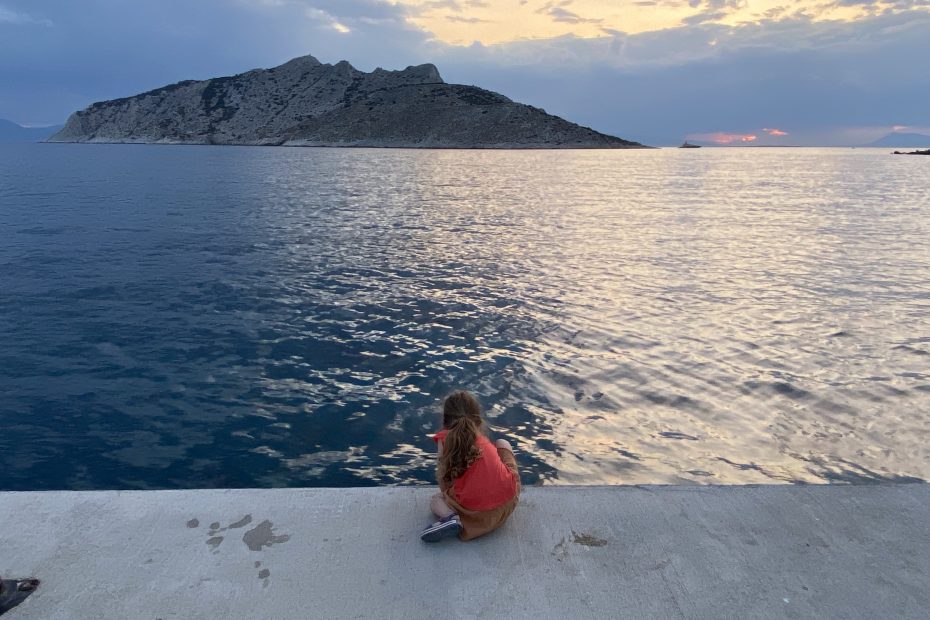
It was almost dark before we were ready to leave. We stayed in the dock. The night was calm, but even so, we slept badly. Every time the stern waves from the large ships reached the shore and rolled into the little dock, we woke as they made Heron jerk alarmingly against her short mooring lines.
As the boatyard began to wake up, we started the engine, cast off and waved to an early-rising Panagiotis as we headed out. Once we were well clear of the coast, we sailed along the northern side of Aegina, then changed course and headed for Poros, just under 20 nautical miles to the south.
Half an hour later, Aegina Marina was abeam. There were many boats anchored outside the marina. Presumably that meant all the berths inside were taken. Good thing we had prepared the boat and spent the night in the little dock at Asprakis.
Moni dead ahead?
Dead ahead lay the small island of Moni, home to wild goats, deer, peacocks and squirrels amid its rich and varied vegetation. How the animals came to the island is unknown. Some say that an islander brought the peacocks there when the island was still inhabited, while the deer are said to have been introduced by a foreigner who did not know what else to do with the animals he had, for reasons unknown, decided to find a new home for.
We had been to the island before.
The day after Thijs & Sarah’s wedding, we had sailed out there with the newlyweds and the other guests. Curious deer and peacocks came to greet us as our little excursion boat arrived at the wooden jetty. We had swum from a small beach in crystal-clear water, turned turquoise by the pale sandy bottom, before taking the short boat ride back to Perdika on Aegina late in the afternoon.
Now, seven months later, the island seemed larger and its summit higher than we remembered. But the navigation instruments, which we had switched on even though we knew these waters, were in no doubt.
It was Moni, dead ahead.
Geothermal energy, health and bankruptcy
We sailed into the narrow strait between Aegina and Moni and from there reached the southern tip of Aegina. To port lay the open Aegean Sea. On the horizon, we could make out some of the Cyclades. After a couple of nautical miles, we reached the northern tip of the Methana peninsula on the Peloponnese, and now had the coast close to starboard.
Methana is known for its underground volcanic activity, which feeds a number of hot springs.
The springs were known in ancient Greece. Pausanias, the Roman-era geographer and travel writer, wrote about them and the geothermal activity almost two thousand years ago in his Description of Greece.
When therapeutic thermal baths became popular in modern times, a large spa complex was built in 1917 beside one of the peninsula’s three springs.
The complex was designed by the German professor and architect Ernst Ziller, who restored and designed numerous buildings throughout Greece.
At one time, it was one of the most popular spa resorts in Greece, but gradually it lost its visitors.
Shortly before the debt crisis, the state privatised the complex. Two brothers took it over on a 50-year lease. But breathing new life into a fading former state-run enterprise was not easy. Ten years later, the business went bankrupt.
Today, the handsome neoclassical building and its large pool of therapeutic sulphurous water stand abandoned. They have done so for six years. Almost as if waiting for someone to come along and open the place again.
Poros
As you approach Poros, the first thing you notice is the many whitewashed houses with red-tiled roofs. They wind their way up two hills, like the tiers of an amphitheatre with the harbourfront as its stage. At the top of one hill stands the town’s landmark: a white-and-blue lookout tower with a clock and bell, which has given it its name, the Clock Tower.
The bay is busy. Yachts mingle with scheduled ferries and tourist boats. To port, you pass a couple of sheltered bays where yachts lie at anchor outside tavernas, while bathers relax beneath parasols on sun loungers right by the water’s edge.
The traffic increases. A car ferry from Galatas on the Peloponnese crosses our course, and to starboard we spot the entrance to a strait. Here, things begin to feel almost chaotic. Small water taxis dart across the channel while a noisy hydrofoil catamaran insists on holding its course, blasting deafening warning signals until two yachts finally get the message and give way.
The strait is narrow, no more than a couple of hundred metres across. But the channel, hugging the town quay with its busy yet somehow relaxed life, is narrower still. Barely fifty to a hundred metres wide.
It must be something like sailing along a canal in Venice.
Two islands, one name
Poros is not only the main town but also the only town on the island of Sphairia. Houses and a few shops have spread onto the much larger but more sparsely populated island of Kalavria, which is connected to Sphairia by a road crossing a narrow canal.
In everyday speech, the islands, which in practice form a single whole, are simply called by the more convenient name Poros. The Greek word for a passage or strait.
Capital
The uprising against the Ottomans and the struggle for an independent Greece began on the Peloponnese.
The harbour and passage of Poros therefore acquired great strategic importance and became a base for the Greek fleet.
It was here that ambassadors from France, Britain and Russia met to determine the borders of the new nation.
Poros became the seat of the provisional government, but when the National Assembly convened, it was decided that Nafplion on the Peloponnese should become the capital.
But the new Greece was more than the Peloponnese. It also included a large area of the mainland. A few years later, the capital was moved to Athens, which in 1834 had only around 7,000 inhabitants and was a far cry from the city of its ancient glory.
Several years later, the naval base was also moved to the mainland near Athens.
The best berth
The town quay in Poros is long. The western side can become uncomfortable when the wind blows from the west. The southern side, on the other hand, is well protected from wind and waves from every direction. But there are also nightclubs here, where loud voices mingle with the monotonous thump of electronic music until well into the night.
“They have to make a living too,” Katharina, one of the harbour guards, had told us rather diplomatically.
But farther along, roughly from where the church stands, it is quiet.
It was late morning. The breeze that later blows cooling across the quay would make berthing difficult, but for now there was neither wind nor current and only a couple of boats alongside.
We dropped the anchor well out from the church, then put the engine into reverse. Once the propeller had a firm grip on the water, we steered straight back towards the quay.
There we were greeted by Jytte and Aage with a cheerful, “That went well! And welcome.”
They had arrived in Poros a couple of days earlier and knew all about our somewhat strained relationship with Mediterranean-style mooring. Now they were on their way back to the Ionian Islands, where we had first met three years earlier.
A little later, we got a neighbour to port: a large motorboat that intended to stay for a while. A couple of hours later, another neighbour arrived to starboard. By now the sea breeze had picked up and was blowing across the quay.
But that was no problem for our new neighbour. They dropped their anchor a couple of metres to starboard of ours and reversed confidently and at right angles into the berth beside us.
“A while,” they replied when we asked how long they planned to stay.
Great.
Now we no longer had to worry about being hit by new neighbours who might have an even more strained relationship with Mediterranean-style mooring than we did.